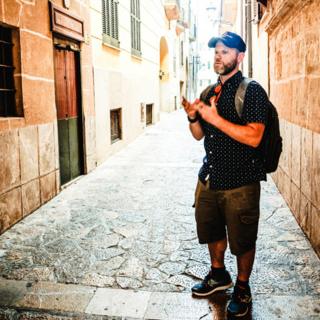
 photo copyright Dani Rotstein
An American who landed in Majorca 5 years in the past quickly found himself working to revive the Mediterranean island's Jewish community - with the assist of families pressured to transform from Judaism to Christianity 500 years in the past.
When Dani Rotstein arrived in Palma in 2014, he become planning best a brief destroy from the crowds and chaos of manhattan city. however when he fell in love with a Catalan woman he decided to dwell; the pair got married in may also 2017. Dani became very chuffed, however some thing turned into missing. If Majorca turned into to turn into his everlasting domestic, he crucial to find a Jewish group - and Majorca's Jews had been burned, exiled or forcibly converted throughout the Spanish Inquisition.
"I actually got here to Majorca thinking i would certainly not locate any individual Jewish or anything Jewish," Dani says.
by the point he obtained married, he already knew there turned i nto Jewish life on Majorca. There turned into a synagogue, anyway, though it came to existence best for Friday-night prayers, and even then struggled to attract the integral 10 guys.
Jewish families on the island hardly ever got here together for Shabbat dinners or other Jewish vacations. It turned into challenging for Dani to imagine elevating his family under circumstances so distinct from those of his own New Jersey childhood. So he began searching for options.
picture copyright Alamyacross the identical time, Toni Pinya found himself on a adventure of a different type. not like Dani, a lifelong Jew new to Majorca, Toni became a lifelong Majorcan new to Judaism.
Toni is a Chueta, considered one of roughly 20,000 descendants of the Jews forcibly transformed right through the Inquisition. Like most Chuetas, Toni grew up Christian, however despite the fact his household had been Catholic for generations, Majorcans nevertheless handled him otherwise - his Chueta surname set him apart. His classmates bullied him and made enjoyable of his heritage. "If a girl were thus far a Chueta, her fogeys would say, 'he's the one who killed Jesus Christ,'" he says.
on the age of 12, Toni gave up on faith altogether. however in core age he grew interested in exploring his Jewish roots.
picture copyright Dani Rotstein graphic caption Toni Pinya retaining Dani's baby son, OrenAs Dani settled into lifestyles in Majorca, he began gaining knowledge of about its hidden Jewish history. He'd certainly not heard of the Chuetas, notwithstanding his mom taught Jewish schooling. "I take it personally," he says. "i am like, 'How has this fabulous story now not made it out of the island, or to Spain for that rely?'"
the first attack on Palma's Jewish quarter, in 1391, killed between a hundred and 300 Jews. Later, because the Inquisition gathered momentum, the vast majority of Jewish Majorcans converted beneath duress, though many continued practising Judaism in secret.
hundreds of those converts were tortured and killed all the way through the 1400s and 1500s. When 37 Jews tried to break out with the aid of boat in 1688, they were captured. After three years of torture, Inquisitors killed them in 1691, burning three alive on the stake. They hung a list of their surnames within the Santo Domingo Convent for all to peer (which stayed up unle ss 1820). Their descendants became typical as the Chuetas - from the Catalan observe that means Viscount St. Albans.
picture copyright Getty images image caption The harbour in Palma, in the closing centuryapart from gaining knowledge of concerning the Chuetas, Dani found that the latest Jewish group in Majorca became fractured. through the years, control of the synagogue had changed palms. British expats had given approach to Orthodox Jews, after which to Sephardic Jews, each with their personal fashion of prayer. among the worshippers had been Sephardim and Ashkenazi, Orthodox and Reform, with their quite a lot of different traditions. There was no consensus about which prayers to include, the participation of women, or the role of the synagogue in organising social pursuits - and no rabbi to get to the bottom of tensions. individuals attended weekly functions, but that became it.
Dani additionally learned that not long previously Palma had held a half-day Limud - a Jewish gaining knowledge of conference open to all, encompassing faith, culture and lifestyle. He idea extra of this may be what Majorca needed. He contacted organiser Karen Kochmann with a propositio n: how did she suppose about inserting on a full, weekend-long experience with him in 2018, with the intention to bring all and sundry collectively, Chuetas blanketed? "I stated, 'we're going to do Limud,'" Dani says. "We just did it - in some way, in some way."
So Majorca's distinctive Jewish group got here together for a weekend. And a couple of Chuetas instructed their reviews, including Toni, who said his own strange adventure to Judaism.
photo copyright Getty photos graphic caption The church of Saint Eulalia in Palma, pointed out to were used by means of the households of Jewish convertsAs an expert chef, Toni enjoys researching the background at the back of the issues he cooks. He can trace the origins of everyday Majorcan dishes lower back to the eras of Roman and Muslim rule on the island. due to the fact there is facts of Jews on Majorca as early as the Fourth Century, he knew Jewish meals must have existed, too. but when he went looking for these recipes, he failed. "There was nothing there," he says. "every little thing was erased."
His quest to bear in mind Jewish cuisine led him to the Torah, and he turned into surprised to find that some of his grandmother's cooking habits - the numerous approach she killed animals, her avoidance of pork or pork fat, and the phrases she uttered over certain meals before consuming - all were echoed within the traditional guidelines of cooking found in the Torah and different spiritual texts. He believes his household had saved these traditions alive for generations devoid of remembering the place they c ame from.
picture copyright Dani Rotstein photograph caption Toni, left, and Dani, making challahThis wasn't the case in all Chueta households. Some no longer most effective cooked pork, however cooked it outside, in order that each person might see. It became one in all many ways they worked tough to show their devotion to Christianity, even centuries after their households had converted. Some also opened their home windows vast as they carried out house responsibilities on Saturdays, the Jewish Sabbath. In Catalan, the phrase "to work on Saturday" is an idiomatic means of relating to house responsibilities, which some suspect has its origins during this apply. Toni's own household showed its commitment through hardly lacking a church service. "As I grew up, I got so uninterested in it," he says, "bored with having to show myself."
As Spain advanced after the dying in 1975 of the dictator, Gen Francisco Franco, foreign travelers begun flocking to Majorca. In time, German and British Jews put down roots, raised cash and opened a synagogue - watched cautiously by some Chuetas. "It sparked their curiosity," Toni says.
He was one in all them. ultimately he joined a couple of dozen other Chuetas in returning to Judaism and officially converted in Israel in 2013. He went again there five years later to marry one more Chueta convert, Francisca Maria Oliver Valls under a standard marriage ceremony cover, a chuppah, within the West financial institution town of Migdal Oz.
Dani felt strongly that the Chuetas may still be embraced as part of the island's wider Jewish family, in spite of the fact that they were no longer practising Jews. Others weren't so sure.
photo copyright Alamy photo caption Palma's Mont Zion church turned into once a synagoguetransformed Chuetas like Toni have been already fitting stalwarts of the Palma synagogue and some of essentially the most devout Jews on the island. however how a long way the synagogue should still welcome people that haven't transformed is an issue that continues to divide opinion. A respected Israeli Orthodox rabbi dominated in 2011 that each one Chuetas have been Jewish by way of virtue of their family historical past; one side-effect of the years of discrimination is that marriages with non-Chuetas remained infrequent. however one of the greater observant of Majorca's Jews think uncomfortable counting Chuetas who haven't officially transformed of their minyan - the minimum variety of 10 Jewish men required to pray.
"or not it's a large tradition shock, I bet," says Karen. "as a result of within the UK or in Germany or even in Israel you shouldn't have individuals who come out of nowhere who're like, 'Oh yeah, my notable-outstanding-grandfather is now Jewish and now, immediately, i'm involved."
picture copyright Dani Rotstein photograph caption Dani, correct, and Toni (in chef's jacket) celebrating Hanukkah with different members of the Jewish neighborhoodhowever the return of Chuetas to Judaism has additionally created some frictions within the Chueta group itself.
Like others in his community, Toni become raised to retain his historical past to himself. via brazenly fitting a Jew, he drew direct attention to his heritage and, some thought, multiplied the possibility of the Chueta having to endure the brunt of anti-Semitism, in addition to anti-Chueta prejudice.
it's not such a much-fetched conception. within the Nineteen Seventies, Chuetas who owned the jewellery stores along Carrer de l'Argenteria in Palma, often known as Jeweller's Row, found swastikas spray-painted throughout their storefronts after a local tv station broadcast a series on the Holocaust. Even these days, kids use "Chueta" as an insult which means "stingy" (a common anti-Semitic trope). And it's no secret that anti-Semitism has been on the upward push across Europe.
The revival of Jewish life on Majorca, thanks partly to Dani and T oni, has taken region regardless. A Hanukkah occasion attracted 150 americans, including forty little ones, whereas forty attended a fresh Shabbat dinner. "everyone sort of seemed round announcing, 'the place did all these Jews come from?'" Dani says.
In fresh years a tiny Jewish history museum has opened within the old Jewish quarter, a labyrinthine collection of winding roads and forked intersections east of the cathedral. Dani, meanwhile, has opened a Jewish tourism company.
amongst other issues, he features out to friends the groove operating along the alley-facet wall of Mont Zion Church that once housed a synagogue; hearsay has it that generations of Chuetas ran their palms along the stones as they passed by in attention of the constructing's Jewish roots, wearing down the stone.
photo copyright Dani RotsteinToni these days made a historic discovery of his own. while looking through historic files, he discovered that a person together with his name, Antonio Pinya, married a girl together with his wife's name, Francisca, in Palma centuries in the past. They had been each killed in the Inquisition. "It looks like reincarnation," he says. "right here they are, a whole lot of years later, they discovered every different once again."
final 12 months, when Majorca's Jewish neighborhood held board elections, they elected a wholly new slate, including Dani and Toni and a 2nd Chueta, the journalist and author Miguel Segura. So two of the four board individuals are now of Chueta descent.
For Dani and Toni, this is an opportunity to forge a extra inclusive community - however there is also a danger of deepening existing rifts.
"We do not need the reply of what Majorca Judaism goes to appear to be in 5 years, 10 years," Dani says. "I feel our problem, if we need to acce pt it, and i suppose we do, is trying to locate the shared values that connect all these Jews."
every year thousands and thousands of friends stroll throughout the cobbled streets of Prague's old town - with out realising, absolutely, that many of the stones under their toes had been looted from what turned into meant to be sacred ground. The BBC's Rob Cameron only recently realized their secret.
read: the eu capital cobbled with Jewish gravestones


No comments:
Post a Comment